Google – AFP,
14 October 2013
 |
A
Palestinian child takes part in a march organised by the ruling Islamic Hamas
movement in Gaza's Nusseirat refugee camp on September 27, 2013 (AFP/
File,
Mahmud Hams)
|
Jerusalem —
Israel's army has agreed to test alternative treatment for Palestinian children
it arrests in the West Bank following international pressure to introduce
reforms, the UN Children's Fund said on Monday.
UNICEF,
which in a March 2013 report described mistreatment of children in Israeli
prisons as "widespread," said in a statement that Israel was taking
steps towards addressing that report's recommendations.
The
measures being tested include the Israeli Defence Forces (IDF) issuing summons
for children instead of arresting them at night at their homes.
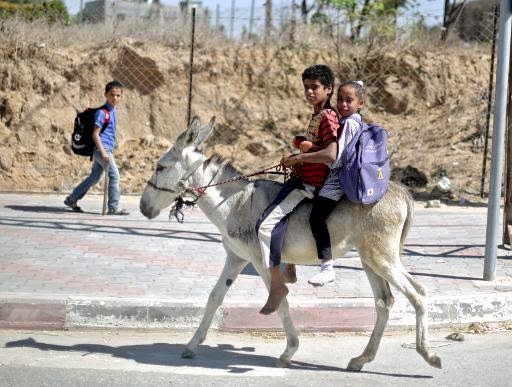 |
A
Palestinian boy rides a donkey with his
sister on the way to school on October
8,
2013, in Beit Lahia in the northern Gaza
Strip (AFP/File, Mohammed Abed)
|
But UNICEF
stressed in a progress report published Monday that "violations are
ongoing," citing 19 sample cases of alleged abuse of teenage boys in the
West Bank in the second quarter of 2013.
In all
cases, the boys suffered physical violence, including beating, kicking and
slapping, while in 17 cases they were verbally abused.
UNICEF's
March report, entitled "Children in Israeli Military Detention," said
Israel was the only country in the world where children were systematically
tried in military courts and gave evidence of practices it said were
"cruel, inhuman and degrading treatment or punishment."
"Ill-treatment
of Palestinian children in the Israeli military detention system appears to be
widespread, systematic and institutionalised," it concluded, outlining 38
recommendations.
Over the
past decade, Israeli forces have arrested, interrogated and prosecuted around
7,000 children between 12 and 17, mostly boys, UNICEF found, noting the rate
was equivalent to "an average of two children each day."
"The
monthly average for 2013 shows that 219 children per month were in Israeli
military custody, compared to 196 per month in 2012, marking a 12 percent
increase," UNICEF said on Monday.
No comments:
Post a Comment
Note: Only a member of this blog may post a comment.