 |
| The Dalai Lama arrives for prayers wishing him a long life at the Tsuglagkhang temple in McLeod Ganj, India in September 2019 -- the US wants the UN to look at the issue of who will succeed him (AFP Photo/Lobsang Wangyal) |
Washington (AFP) - The United States wants the United Nations to take up the Dalai Lama's succession in an intensifying bid to stop China from trying to handpick his successor, an envoy said after meeting the Tibetan spiritual leader.
Sam
Brownback, the US ambassador-at-large for international religious freedom, said
he spoke at length about the succession issue with the 84-year-old Dalai Lama
last week in the monk's home-in-exile of Dharamsala, India.
Brownback
said he told the Dalai Lama that the United States would seek to build global
support for the principle that the choice of the next spiritual chief
"belongs to the Tibetan Buddhists and not the Chinese government."
"I
would hope that the UN would take the issue up," Brownback told AFP after
returning to Washington.
He
acknowledged that China, with its veto power on the Security Council, would
work strenuously to block any action, but he hoped countries could at least
raise their voices at the United Nations.
"I
think it's really important to have an early global conversation because this
is a global figure with a global impact," he said.
 |
US
religious freedom envoy Sam Brownback, seen here at a July 2019 ministerial
meeting in Washington, is raising pressure over the Dalai Lama's succession
(AFP
Photo/MANDEL NGAN)
|
"That's
the big thing that we're really after now, to stir this before we're right in
the middle of it -- if something happens to the Dalai Lama, that there has been
this robust discussion globally about it ahead of time," he said.
"My
estimation undoubtedly is that the (Chinese) communist party has thought a lot
about this. So they've got a plan and I think we have to be equally aggressive
with a plan."
The Dalai
Lama once traveled incessantly, drawing huge Western audiences with his
good-humored lectures on compassion and happiness.
But the
Nobel Peace Prize winner has slowed down and earlier this year suffered a chest
infection, although he is not known to have serious health issues.
Brownback
said he found the Dalai Lama "quite jovial" and that the monk had
told him, "'Look, I'm going to live another 15, 20 years; I'm going to
outlast the Chinese government.'"
But Beijing
has indicated it is waiting out the Dalai Lama, believing his campaign for
greater Tibetan autonomy will end with him.
China,
which argues that it has brought modernization and development to the Himalayan
region, has increasingly hinted that it could name the next Dalai Lama, who
would presumably be groomed to support Chinese rule.
In 1995, the officially atheist government selected its own Panchen Lama and detained a six-year-old identified for the influential Buddhist position -- whom rights groups called the world's youngest political prisoner.
 |
Indian
police detain Tibetan students as they protest against the visit of
China's
President Xi Jinping in Chennai in October 2019 (AFP Photo/STR)
|
In 1995, the officially atheist government selected its own Panchen Lama and detained a six-year-old identified for the influential Buddhist position -- whom rights groups called the world's youngest political prisoner.
Seeking
'unfettered' access
Mindful of
Beijing's plans, the 14th Dalai Lama has mused about breaking with the
centuries-old tradition in which wandering monks look for signs that a young
boy is the reincarnation.
He has said
that he could pick his own successor, possibly a girl, or even declare himself
the final Dalai Lama.
The US
Congress has also stepped up efforts, including by mandating visa denials by
the end of the year for Chinese officials unless Beijing eases restrictions on
US diplomats, journalists and ordinary people seeking to visit Tibet.
Brownback
said he would like access to Tibet, "but I want it unfettered."
He said he
similarly hoped to visit the western region of Xinjiang, which has drawn
intense US scrutiny over the incarceration of some one million Uighurs and
other Turkic-speaking Muslims.
"It is
part of the same war on faith," Brownback said of Tibet and Xinjiang.
Fears in Nepal
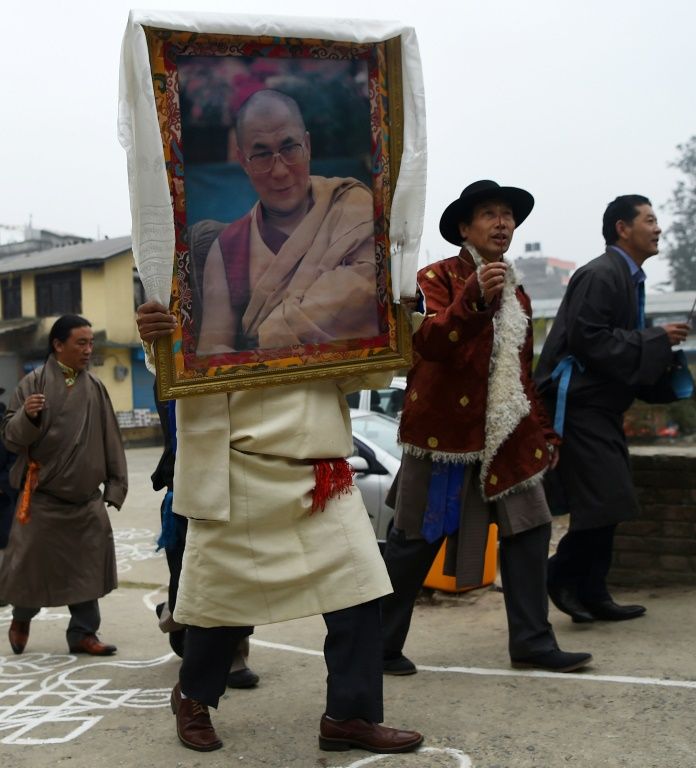 |
A
Tibetan-in-exile carries a photograph of the Dalai Lama during celebrations
marking the Lunar New Year in Kathmandu in February 2018 (AFP Photo/
PRAKASH
MATHEMA)
|
Fears in Nepal
Brownback
also visited Nepal, historically the gateway for Tibetans fleeing to India but
which has increasingly clamped down under pressure from its giant northern
neighbor.
Brownback
said he raised fears for Tibetans with Nepal's foreign minister, Pradeep
Gyawali.
But he
acknowledged Nepal's difficult situation and said: "I would hate to be
very harsh on the Nepalese because they've been so good over so many years to
help the Tibetans."
Brownback
said that the burden was ultimately with China to allow freedom of movement --
and not to interfere in Tibetan Buddhism.
"A
government doesn't own a religion," he said. "A religion runs
itself."
"We
hope we'll get a number of other communities around the world to express
similar positions and concerns."
No comments:
Post a Comment
Note: Only a member of this blog may post a comment.