 |
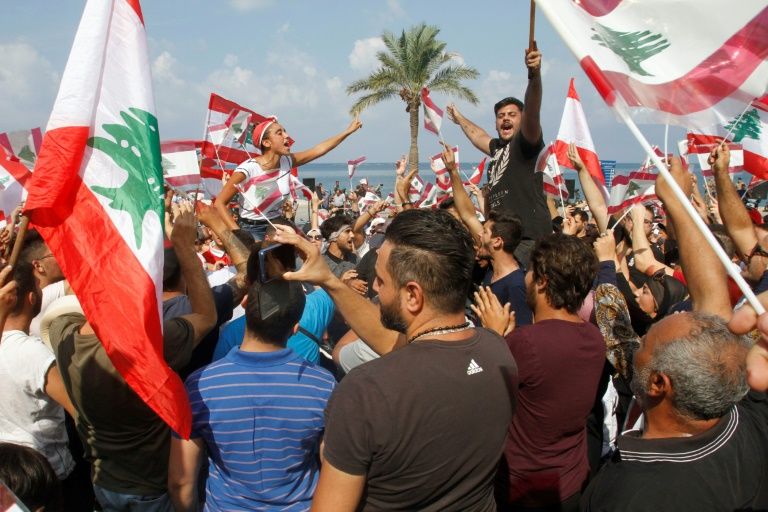
| Lebanese protests have grown into an unprecedented cross-sectarian street mobilisation against the political class (AFP Photo/Anwar AMRO) |
Beirut (AFP) - When mass anti-government protests engulfed Lebanon, a taboo was broken as strongholds of the Shiite Hezbollah movement saw rare demonstrations criticising the party and revered leader Hassan Nasrallah.
On live TV
and in protest sites, citizens accused the party of providing political cover
for a corrupt government that they say has robbed people of their livelihoods.
This
shattered the myth of absolute acquiesence among Hezbollah's popular base,
baffling even those who hail from the movement's strongholds.
"No
one ever expected that in any of these areas in south Lebanon we would hear a
single word against Nasrallah," or Amal Movement leader Nabih Berri, said
Sara, a 32-year-old activist who participated in protests in the southern city
of Nabatiyeh.
"It's
unbelievable," the activist added, asking to use a pseudonym due to security
concerns.
The popular
Iran-backed movement is a major political player that took 13 seats in the
country's May 2018 parliamentary elections and secured three cabinet posts.
It is the
only political party not to have disarmed after Lebanon's 1975-1990 civil war,
and helped its Christian ally Michel Aoun assume the presidency in 2016.
Popular
dissatisfaction with the government peaked last week following protests over
taxes, corruption and dire economic conditions.
 |
Even in the
southern city of Tyre where Hezbollah and its political affiliate the Amal
Movement hold sway, there were large protests against Lebanon's dire economic
conditions (AFP Photo/Mahmoud ZAYYAT)
|
South
Lebanon -- a bastion of the powerful Shiite movement since the group liberated
the region from Israeli occupation in 2000 -- was not spared.
Protests
have been reported in the cities of Nabatiyeh, Bint Jbeil, and Tyre, where
Hezbollah and its political affiliate the Amal Movement hold sway.
With the
exception of Tyre, they were not as big as other parts of the country.
But
"the novelty here is that some of these protesters are party
loyalists," said Sara.
"They
support Hezbollah, but they are suffocating."
Among his
supporters, Nasrallah is revered as an icon, with his pictures inundating
highways, shops and homes.
In the
past, his followers have mobilised against anyone who tried to criticise him,
often ostracising opponents as supporters of rival Israel.
'The
resistance'
But
anti-government protests that started in Beirut on October 17 and quickly
spread across the country left no politician unscathed, not even the Hezbollah
leader.
"All
of them means all of them, Nasrallah is one of them," protesters chanted
in Beirut.
 |
Hezbollah
leader Hassan Nasrallah has acknowledged the criticism in recent
days telling
protesters: 'Curse me I don't mind' (AFP Photo)
|
Criticism
of Nasrallah even aired on the Hezbollah-run Al-Manar TV, in a scene that was
previously unfathomable for watchers of the movement's propaganda arm.
In a live
interview from central Beirut, one protester urged Nasrallah to "look
after his people in Lebanon" instead of focusing on regional enterprises
like Syria, where he has deployed fighters to defend President Bashar
al-Assad's regime.
Nasrallah
acknowledged the mounting criticism against him in a speech on Saturday:
"Curse me, I don't mind."
Speaking on
the protesters demands, he warned against calling for the resignation of the
government -- saying it could take a long time to form a new one and solve the
crisis.
Hatem
Gharbeel, a protester in Nabatiyeh, said Hezbollah loyalists felt let down.
"The
messages being addressed to Nasrallah by his own supporters in Nabatiyeh is
that the resistance is not just about fighting Israel or terrorism," he
said.
"It
should also be about supporting people's livelihoods."
Other party
heads have come in for even greater criticism.
Prime
Minister Saad Hariri, Foreign Minster Gebran Bassil and Speaker Nabih Berri
have been the targets of strong insults and slurs by demonstrators, even in
areas where they are popular.
 |
Key
socio-economic indicators for Lebanon. (AFP Photo)
|
'Nothing
to lose'
But the
relatively toned-down criticism of Nasrallah has broken taboos, said Gharbeel.
"The
barrier of fear has been broken, " he said.
"It
shows that people are not blindly following their political or sectarian
leaders anymore."
Lokman
Slim, an independent political activist and an outspoken critic of Hezbollah,
said that resentment among Lebanon's Shiite community "is not born out of
a single event or a single moment."
"Frustration
has been fermenting over the past few years over an economic crisis hampering
not just the Lebanese state but also Hezbollah's statelet."
Hezbollah
has filled in for the weak central government in areas where it has influence,
creating social welfare institutions and provided an array of public services,
including education and health services.
But the
group has come under financial strain due to tightening US sanctions since
President Donald Trump assumed office, forcing Nasrallah to appeal to his
popular base for donations earlier this year.
"The
Shiites have nothing to lose anymore," said Slim.
"This
is why they are out on the streets."
No comments:
Post a Comment
Note: Only a member of this blog may post a comment.