Yahoo – AFP,
Annabel SYMINGTON, December 11, 2017
 |
| The landmark elections for national and provincial parliaments capped Nepal's 11-year transition from monarchy to federal democracy after a brutal civil war (AFP Photo/ PRAKASH MATHEMA) |
Nepal's
Communist parties were headed Monday for a landslide win in elections seen as a
turning point after two decades of conflict, political instability and disaster
that have crippled the Himalayan country.
The
landmark elections for national and provincial parliaments capped Nepal's
11-year transition from monarchy to federal democracy after a brutal civil war.
Many hope
they will usher in a much-needed period of stability in the impoverished
country, which has cycled through 10 prime ministers since 2006.
An alliance
of the main Communist party and the country's former Maoist rebels is expected
to form the next government, ousting the ruling centrist Nepali Congress.
"If
Congress had done good work, it would not be wiped out like this from the
country. The people are giving these parties a chance but if they do nothing
for the country, they will also be wiped out," said one voter, 66-year-old
farmer Lachu Prasad Bohara.
The
Himalayan Times said the leftist alliance's strong mandate meant the country
"could experience political stability", which it has lacked over the
last decade, but cautioned that a strong opposition was also crucial in the
young democracy.
With
counting still going on, the alliance has won 105 seats in the national
parliament, according to preliminary data from the election commission. The
incumbent Nepali Congress has won just 21.
 |
An alliance
of the main Communist party and the country's former Maoist rebels
is expected
to form the next government (AFP Photo/John SAEKI)
|
That puts
the alliance on course for a hefty majority in the country's 275-seat
parliament.
The
assembly is made up of 165 directly-elected seats, while the rest are allocated
on a proportional representation basis, guaranteeing seats for women, people
from indigenous communities and the lowest Dalit caste.
The
Communist bloc is also leading in six out of seven provincial assemblies
mandated in a new national constitution.
The charter
was finally agreed by parliament in 2015 in a rare moment of cross-party consensus,
months after the country was devastated by a powerful earthquake. It laid the
ground for a sweeping overhaul of the political system to devolve power from
the centre to newly-created provinces.
It was
intended to build on the promise of a more inclusive society, integral to the
2006 peace deal that ended the decade-long civil war between Maoists and the
state.
But the
constitution sparked deadly protests among ethnic minorities who said the
provincial boundaries it laid out had been gerrymandered to limit their voice.
Relations
with China, India
The leftist
alliance campaigned on a promise to bring economic growth to Nepal.
 |
The
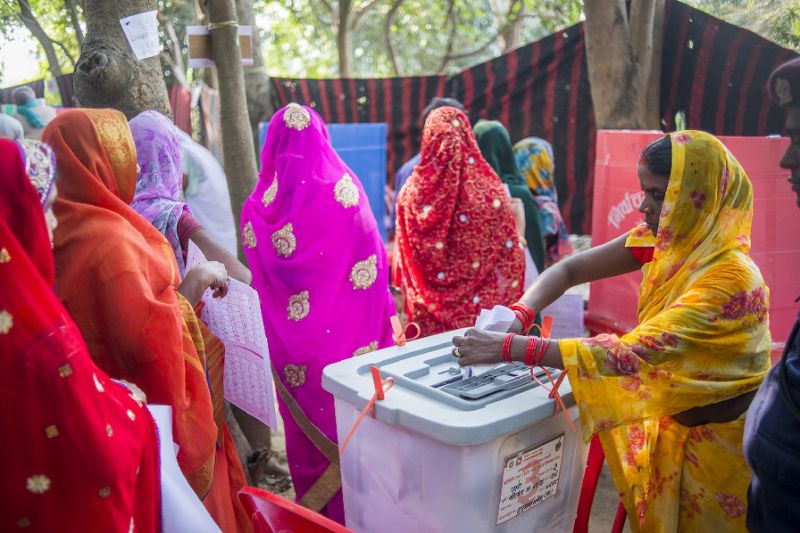
Communist bloc is also leading in six out of seven provincial assemblies
mandated in a new national constitution (AFP Photo/Manish Paudel)
|
"We
will take the country towards peace and stability and move forward on the road
of prosperity," Communist Party of Nepal (CPN-UML) leader K.P. Sharma Oli
said in a television interview late Sunday.
Oli is
expected to be elected as the next prime minister when parliament sits for the
first time, likely in early January.
Maoist
leader Pushpa Kamal Dahal, a two-time former prime minister who led the rebel
faction during the war, is also tipped for a prominent position in the next
cabinet.
During
Oli's last term in office, relations between Kathmandu and New Delhi reached a
nadir after protests over the new constitution led to a blockade of the border
with India and a crippling shortage of goods in landlocked, import-dependent
Nepal.
The
Communist leader blamed the blockade on India, stoked nationalistic sentiment
and aggressively courted China for much-needed infrastructure development --
undermining New Delhi's influence over its small northern neighbour.
Analyst
Prateek Pradhan warned that Oli needed to take a more pragmatic approach to
balancing relations with both regional powers if he is to deliver on his
campaign promise of growth.
 |
Most voters
voiced a desire for stability and a longer-lasting government (AFP
Photo/
PRAKASH MATHEMA)
|
"Nepal
has to have good relations with India and that doesn't mean you have to
compromise on sovereignty," Pradhan said.
The
newly-elected provincial assemblies will be tasked with naming their provinces,
which are currently referred to by a number, choosing capitals and negotiating
budgets with Kathmandu -- all issues that could rekindle ethnic unrest.
But the
protest movements have lost momentum as voters have become fed up with the political
merry-go-round that has starved the country of much-needed development.
Most voters
voiced a desire for stability and a longer-lasting government, while also
expressing hope that the provincial assemblies will prioritise local needs.
The new
constitution lays out strict rules for ousting a prime minister, meaning this
government could be the first to last a full five-year term.
Final
results are expected by the end of the week.
Nepal's Communist parties are headed for a landslide win in elections seen as a turning point after two decades of conflict, political instability and disaster https://t.co/qQdl9GN0HM pic.twitter.com/TnE6QF1CdY— AFP news agency (@AFP) December 11, 2017
No comments:
Post a Comment
Note: Only a member of this blog may post a comment.