Yahoo – AFP,
Giles Hewitt, 3 Dec 2015
 |
South
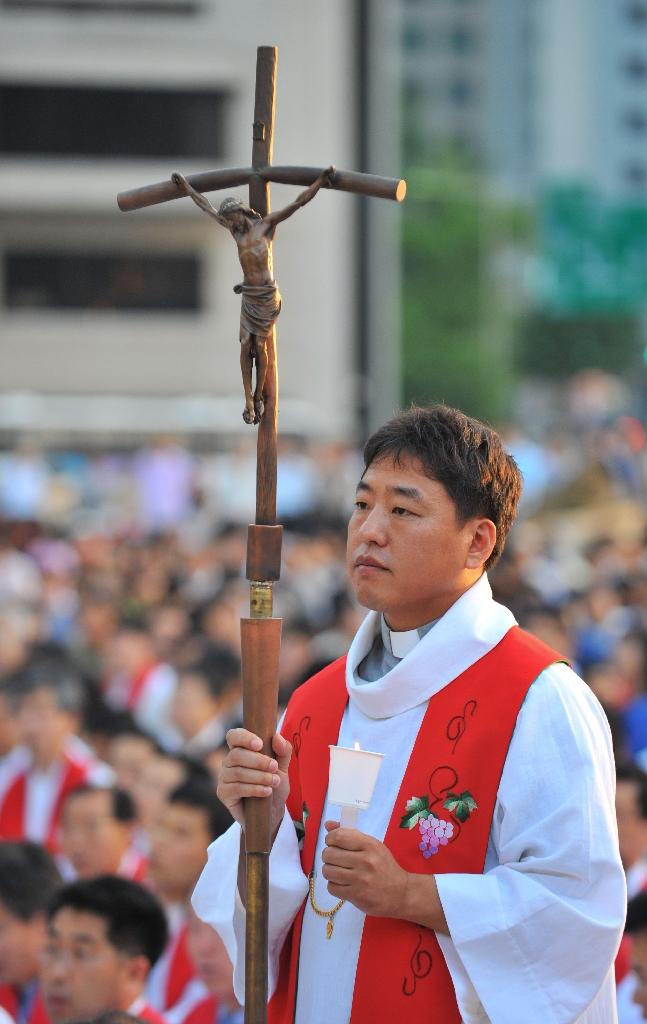
Korea's Catholic priests have voluntarily paid income tax since the
mid-1990s
(AFP Photo/Ed Jones)
|
After a
debate stretching back more than 40 years, South Korea's parliament has
approved a bill that will finally compel the country's influential clergy to
pay taxes.
The bill
was passed shortly before midnight on Wednesday by 195 votes to 20, with 50
legislators abstaining.
It has been
a long road to legislation, with previous efforts to bring monks, priests and
pastors into the national tax fold being repeatedly foiled by vehement clerical
opposition and political timidity.
 |
South
Korean Christians pray during
a service at a church in Seoul (AFP
Photo/Choi
Won-Suk)
|
Kang
Seog-Hoon, a legislator with the ruling Saenuri Party, said the grace period
would be used to communicate with religious groups "so that the policy can
settle down without turbulence".
South Korea
has an estimated 360,000 priests and monks whose earnings will be re-classified
as "religious income" rather than the current label of
"honorarium".
A sliding
bracket means those earning 40 million won (34,500 dollars) or less a year will
only be taxed on 20 percent of their income.
At the
upper end, those earning more than 150 million won will have to pay tax on 80
percent of their income.
Public
opinion polls have long favoured extending tax responsibilities to religious
groups, some of whom are highly secretive about their financial arrangements.
"Pastors
who receive benefits and gifts outside of their monthly income and do not pay
income taxes can be perceived as not doing their duties as members of the
community," said Kim Ai-Hee, secretary general of the Korean Christian
Alliance for Church Reform.
Muscular
religious faith
For many
first-time visitors to Seoul, a common take-away memory is the surprising
multitude of neon crosses glowing across the South Korean capital's nightscape.
The theory
that prosperity and socio-economic development tend to breed secularism holds
little water in a country where modernity appears to have fuelled religiosity.
 |
In the last
national census to include religious affiliation, conducted in 2005,
23% of
South Koreans identified themselves as Buddhist (AFP Photo/Ed Jones)
|
In the last
national census to include religious affiliation, conducted in 2005, close to
30 percent of South Koreans identified themselves as Christian, and 23 percent
as Buddhist.
Catholic
priests have voluntarily paid income tax since the mid-1990s, and the most
vocal opponents of the new policy are within the larger Protestant community
which wields considerable political clout.
Some
individual Protestant churches boast enormous congregations and considerable
wealth, and are run like mini-fiefdoms with pastors passing control of the
church and its business down to their children.
Last year,
the pastor of the biggest congregation of all, at the Yoido Full Gospel Church
in Seoul, was handed a three-year suspended jail term for embezzling millions
of dollars.
But the
opponents of taxation insist their stance is grounded in principle rather than
self-interest.
"Taxing
religious practitioners equates religious activities with commercial
activities," a conservative Protestant group, the Commission of Churches
in Korea, said in a statement.
A spokesman
for the commission, Choi Kwi-Soo, also noted that Protestant pastors who,
unlike monks and Catholic priests, generally marry and have families, would be
hardest hit.
 |
South
Korean Protestant community
wields considerable political clout
(AFP Photo/Kim
Jae-Hwan)
|
Fears of
a backlash
Attempts to
tax the clergy date back to 1968 when Lee Nak-Yeon, the first head of the
National Tax Service, argued they should not be exempt from what amounted to a
basic civic duty.
Lee's baton
was picked up many times over the years, most recently in 2013 when the
government pushed to legalise taxes but then folded in the face of strong
opposition from powerful religious figures.
South Korea
holds parliamentary elections in April next year, followed by a presidential
vote at the end of 2017, and many observers say those events are the real
reason for the tax bill's two-year grace period.
The
protestant church enjoys substantial political influence in some
constituencies, and MPs from the conservative Saenuri Party fear they will be
the main victims of any backlash.
Supporters
of the bill are concerned that the 2018 start date leaves the policy vulnerable
to political changes that could delay implementation.
No comments:
Post a Comment
Note: Only a member of this blog may post a comment.