Yahoo – AFP, Park Chan-Kyong, December 28, 2015
South Korea and Japan reached agreement Monday on their dispute over wartime sex slaves that has soured relations for decades, as Tokyo's leader hailed a "new era" in ties with Seoul.
 |
| South Korea's Foreign Minister Yun Byung-Se (R) and his Japanese counterpart Fumio Kishida meet at the Foreign Ministry in Seoul on December 28, 2015 (AFP Photo/Jung Yeon-Je) |
South Korea and Japan reached agreement Monday on their dispute over wartime sex slaves that has soured relations for decades, as Tokyo's leader hailed a "new era" in ties with Seoul.
Japan
offered a "heartfelt apology" and a one-billion yen ($8.3 million)
payment to Korean women forced into Japanese military brothels during World War
II.
Now the two
countries, both close US allies, "will welcome a new era", Japanese
Prime Minister Shinzo Abe told reporters in Tokyo after speaking by phone with
South Korean President Park Geun-Hye.
The fate of
the 46 surviving South Korean "comfort women" is a hugely emotional
issue in South Korea, and a source of much of the distrust that has marred
relations with its former colonial ruler Japan for decades.
The deal
would be "final and irreversible" if Japan fulfils its
responsibilities, South Korean Foreign Minister Yun Byung-Se said after talks
in Seoul with his Japanese counterpart Fumio Kishida.
Kishida
said the issue was "one that deeply hurt the women's honour and dignity
with the involvement of the (Japanese) military at the time, and from this
viewpoint the Japanese government keenly feels its responsibility".
Abe, he
said, extends "his feeling of heartfelt apology and regret to all of those
who as comfort women have suffered great pain, both mentally and physically,
that is difficult to heal".
"I
think the agreement we reached is historic and is a ground-breaking
achievement," Kishida said.
 |
South
Korean former "comfort woman" Lee Yong-Soo (C), who was forcibly
recruited to work in Japanese wartime brothels, and supporters demonstrate near
the Japanese embassy in Seoul on October 30, 2015 (AFP Photo/Jung Yeon-Je)
|
The US also
welcomed the agreement, with National Security Advisor Susan Rice calling it
"an important gesture of healing and reconciliation that should be
welcomed by the international community".
As part of
the agreement Seoul will try to relocate a statue symbolising comfort women
which currently stands in front of the Japanese embassy through consultations
with relevant NGOs, South Korea's Yun said.
He said
Seoul would also refrain from bringing up the comfort women issue again in
international forums such as the United Nations.
"I am
very pleased to declare the successful conclusion of the difficult negotiations
before the year is out, the 50th anniversary of diplomatic ties," Yun
said.
Mixed
reactions
Up to
200,000 women, many of them Korean, are estimated to have been sexually
enslaved by Japan during World War II.
Japan has
long maintained that the dispute was settled in a 1965 agreement which saw
Tokyo establish diplomatic ties and make a payment of $800 million in grants or
loans to Korea, which it ruled from 1910-1945.
Kishida
said Monday the one-billion-won payment was not compensation but a project to
restore the women's dignity.
South Korea
has said the 1965 treaty did not cover compensation for victims of wartime
crimes such as comfort women, and did not absolve the Japanese government of
legal responsibility.
But when
Park met Abe in Seoul last month for a rare summit, they agreed to speed up
talks on the issue.
Previously
Park had rebuffed all bilateral summit proposals, arguing that Tokyo had yet to
properly atone for its wartime past and colonial rule.
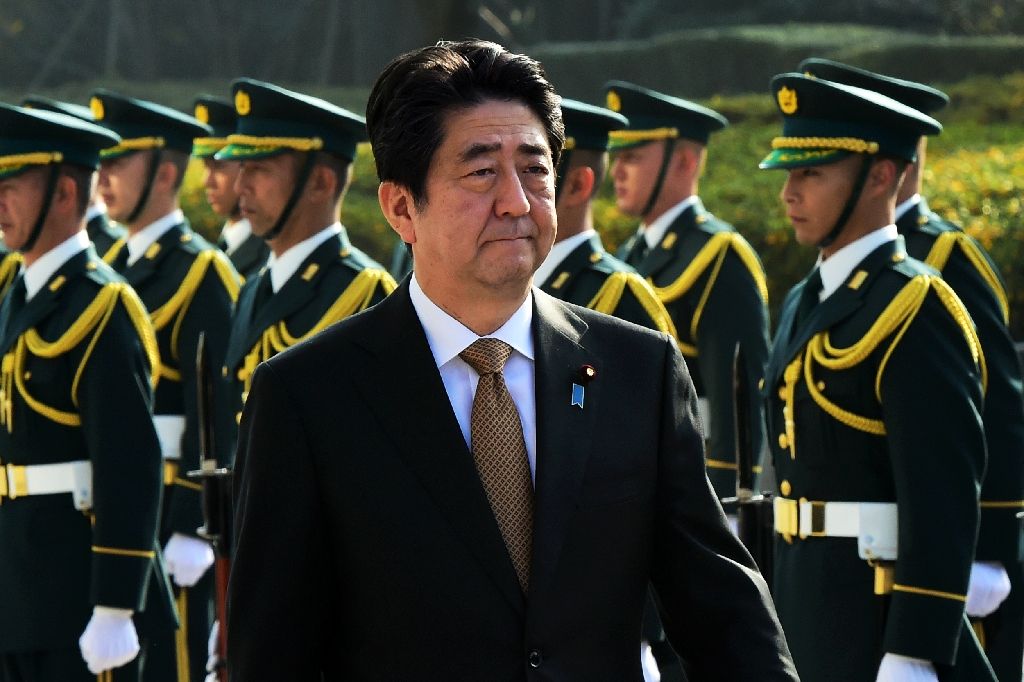 |
Japanese
Prime Minister Shinzo Abe hailed the landmark agreement on
wartime sex slaves
and welcomed a "new era" of ties with South Korea (AFP
Photo/Yoshikazu Tsuno)
|
Former sex
slaves had mixed reactions.
"What
we have been demanding is legal compensation from Japan," said 88-year-old
Lee Yong-Soo.
Yoo
Hee-Nam, another former comfort woman, told Yonhap news agency she was not
satisfied but would accept the government's decision.
Amnesty
International said the agreement should not mark the end of the road in
securing justice.
"The
women were missing from the negotiation table, and they must not be sold short
in a deal that is more about political expediency than justice," said
Hiroka Shoji, its East Asia researcher, in a statement.
Lee
Won-Duk, a professor at South Korea's Kookmin University, said the deal, pushed
by Washington, would help the two countries improve ties.
"With
today's agreement, South Korea and Japan passed the critical point in their
row," added Jin Chang-Soo, a researcher at Sejong Institute in South
Korea.
But Kan
Kimura, an expert on Japan-Sourea relations at Japan's Kobe University, struck
a note of caution.
"This
is an agreement between the two governments, but not between the two societies.
So the next focus is whether the South Korean government can persuade its
public to accept the deal," Kimura told AFP.
No comments:
Post a Comment
Note: Only a member of this blog may post a comment.