Yahoo – AFP,
Shafiqul Alam, 1 June 2015
 |
More than
1,100 people were killed in the Rana Plaza building collapse on
the outskirts
of Dhaka in 2013 (AFP Photo/Munir Uz Zaman)
|
Bangladeshi
police on Monday charged 41 people including the owner of the Rana Plaza
factory complex with murder after the building collapsed killing more than
1,100 people in 2013.
A court in
Dhaka formally accepted charges against Sohel Rana, 35, and the others in
connection with the country's worst ever industrial disaster.
"We've
charged 41 people including the owner of the building, Sohel Rana, with murder
over the collapse of Rana Plaza in April 2013," lead investigator Bijoy
Krishna Kar told AFP, adding that all face the death penalty if convicted.
 |
The Rana
Plaza factory collapse
in 2013 was the country's worst-ever
industrial disaster
(AFP Photo)
|
Rana's
parents, who jointly owned the building with him, and the mayor and councillor
of the town where it was located, were also charged with murder.
Police
asked the court to issue arrest warrants for 25 people including six government
officials after they absconded.
"It is
the biggest industrial disaster in Bangladesh's history. And all 41 of them
have collective responsibility for this mass killing of more than 1,100
innocent people," Kar said.
Rana became
Bangladesh's public enemy number one after survivors recounted how thousands of
them were forced to enter the compound at the start of the working day despite
complaints about cracks appearing in the walls.
He was
arrested on the western border with India as he tried to flee the country in
the days after the April 24 disaster.
Rana and 17
others were also charged with violating the building code, for extending the
six-storey structure -- which was initially approved as a shopping centre --
into a nine-storey factory complex.
"Rana
Plaza was built flouting construction rules and it was extended without proper
structural changes. And when it was turned into a factory complex, it was
loaded with heavy machinery such as a generator. No wonder the building
collapsed," Kar said.
"That
illegal extension violating all construction (regulations) was the seed of this
massive disaster," Kar said on Sunday.
Police
announced last year they were set to charge Rana, but the process was held up
after police needed government approval to frame charges against a dozen
government officials included in the 41, a standard requirement in Bangladesh.
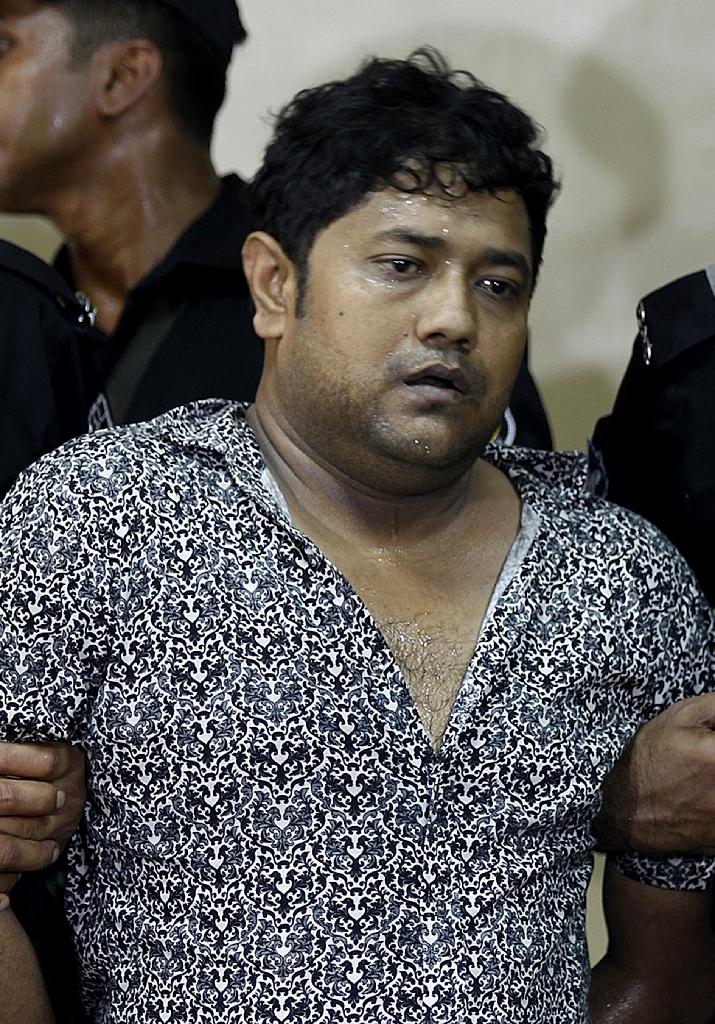 |
Bangladesh
property tycoon Sohel Rana
was arrested on the western border with
India as he
tried to flee the country, in the
days after the 2013 disaster (AFP Photo)
|
A host of
Western retailers had clothing made at Rana Plaza, including Italy's Benetton,
Spain's Mango and the British low-cost chain Primark.
The
disaster prompted sweeping reforms including new safety inspections and higher
wages in the industry, which employs around four million workers.
Kalpona
Akter, head of the Bangladesh Center for Worker Solidarity, welcomed the
charges against Rana and 40 others.
But she
criticised the failure to include the government administrator of the town,
Savar, on the outskirts of Dhaka, where the disaster took place, in the charge
sheet.
"The
Savar UNO (executive officer) also had a role in the tragedy. He inspected the
building when cracks appeared a day before the collapse," she told AFP,
"He
could have easily shut down the complex and saved the workers."
No comments:
Post a Comment
Note: Only a member of this blog may post a comment.