Yahoo – AFP,
4 Jan 2015
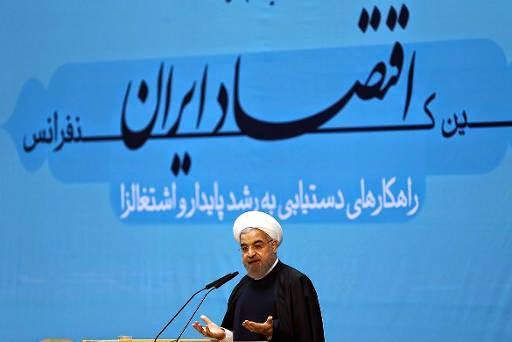 |
Picture
released by the official website of the Iranian president Hassan Rouhani
shows
him speaking during the opening ceremony of the economic conference in
Tehran
on January 4, 2015 (AFP Photo)
|
Tehran
(AFP) - Iran's President Hassan Rouhani said Sunday that foreign investors
should no longer be viewed as a threat and signalled his country's decades-long
isolation from the world economy could soon end.
Speaking at
an economic conference in Tehran, he said the Islamic republic would not give
up its principles but it would be better placed to conclusively emerge from
recession if it opened up.
Iran is
engaged in long-running negotiations with world powers aimed at a comprehensive
deal over its disputed nuclear programme which, if successful, will likely
result in an investment boom.
A key point
in any agreement would be the lifting of wide-ranging sanctions -- imposed on
Iran as punishment for its atomic activities -- blamed for neutering its oil-
and gas-rich economy.
Rouhani
said Iran wanted "lasting and sustainable development" and if it was
to escape the recent years of "constriction" caused by its foreign
policy then change was necessary.
"Our
political life has shown we cannot have sustainable growth while we are
isolated," he told an audience of 1,500 economic experts and guests,
including the economy minister and head of the central bank.
"The
time is past when it used to be said that if a foreign investor comes to Iran,
our independence will be in danger," he added.
The
president's comments alluded to a checkered history of foreign involvement in
Iran's economic affairs, chiefly from Russia and Britain in the oil industry.
In 1953,
British and US intelligence services orchestrated the ouster of democratically
elected prime minister Mohammad Mossadeq, in a coup d'etat after he announced
plans for oil nationalisation.
His
overthrow remains a toxic issue and a rallying point for hardline sceptics of
the West.
The nuclear
talks between Iran and the P5+1 group (Britain, China, France, Russia and the
United States plus Germany) resume in Geneva on January 15, and are aimed at a
political agreement by March and a comprehensive accord by June 30.
During the
negotiations Iran has limited its enrichment of uranium, a process that creates
nuclear fuel but which at high purities can produce fissile material for an
atomic weapon.
Iran denies
seeking the bomb, insisting its nuclear programme is for peaceful energy
purposes.
Although a
nuclear deal is seen as the key to unlocking a dormant economy, Rouhani said
the current curtailment of Iran's nuclear activities should not be considered
as weakness.
Standing
near the conference slogan -- "Sustainable growth that creates jobs"
-- he said: "Our ideals are not connected to (enrichment) centrifuges, but
to our heart and will.
"We
want to stand on our own feet, we want to have less need to export oil... if
these things happen, our nuclear negotiations will move forward faster."
Related Article:
No comments:
Post a Comment
Note: Only a member of this blog may post a comment.