There is
outrage across India over a minister from the ruling BJP party who said that
rape was "sometimes right, sometimes wrong." The remarks come as the
country reels from a series of brutal gang rapes.
Deutsche Welle, 6 June 2014
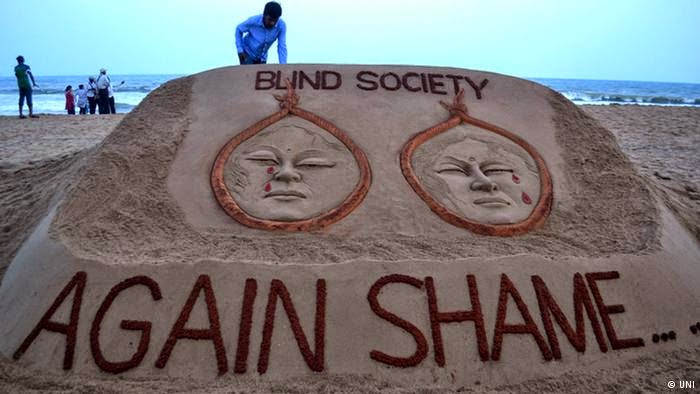
When the
home minister of the central Madhya Pradesh state, Babulal Gaur, described rape
as a social crime, saying "sometimes it's right, sometimes it's
wrong", he not only sparked a huge controversy in the vast South Asian
nation, but also invited the wrath of social media. The minister from PM
Narendra Modi's ruling Bharatiya Janata Party (BJP) also insisted that
governments could not ensure that women do not get raped.
Reactions
The remarks
triggered heated reactions from the Opposition Congress party, and protests
broke out outside the minister's home on Friday, June 6, with women activists
staging a sit-in demonstration and demanding his resignation.
"Gaur
does not deserve to be home minister if women have to protect themselves against
criminals," Mandvi Chouhan, a member of the opposition Congress Party,
told DW.
 |
| The recent brutal rape cases have triggered protests nationwide |
Public
outrage erupted last week following the rape and hanging of two teenage girls
in a rural village of the northern Indian state of Uttar Pradesh. "It is
such a chilling crime. How can anyone expect a minister to talk like
this?" asked Kavita Datta, an Information Technology student.
"We
always knew that we should not expect security and protection from the state,
and that we have to defend ourselves. Gaur's statement is proof of that,"
Priti Goel, a corporate executive in New Delhi, told DW.
Social
media users, too, were quick to denounce Gaur. "A woman in India is raped
every 20 minutes, whereas people like Babulal Gaur make stupid comments every
10 minutes," Magat Jhunjhunwala wrore on Twitter.
"Gaur
needs a tape on his mouth, things will change for the better," tweeted
Harsh Uberoi.
Insensitivity
The Indian
home minister's remarks are the latest in the series of controversial
statements made by the country's lawmakers. Two months ago, Mulayam Singh
Yadav, another politician, challenged the death penalty handed out to three men
convicted in the gang-rape of two women in India's financial capital Mumbai.
Yadav said the culprits did not deserve death sentence since "boys will be
boys," and that "boys make mistakes."
Abu Azmi,
another prominent leader belonging to Yadav's Samajwadi Party, followed suit
saying even rape victims should be punished for getting raped.
 |
| India may have tightened its rape laws, but sexual violence continues unabated, say observers |
In the aftermath
of the brutal gang rape and murder of a young woman on a moving bus in the
Indian capital in December 2012, India tightened its rape laws and expanded the
definition of violence against women. However, sexual violence continues
unabated, say observers.
No comments:
Post a Comment
Note: Only a member of this blog may post a comment.