Deutsche Welle, 27 January 2014
Riot police
were recently deployed in the Cambodian capital Phnom Penh to break up
anti-government protests. The crackdowns are part of an escalating standoff
between officials and those calling for democratic reform.


The January
26 demonstration, announced by nine unions and associations, was in defiance of
a government ban on rallies and marches imposed after a deadly confrontation
between protesters and police in early January. The protesters, who demand
higher wages for garment workers and the release of 23 people detained by
authorities, were expecting up to 10,000 demonstrators at Freedom Park, a
free-speech area in the capital Phnom Penh.
But early
that morning, the park was eerily silent, almost empty but for journalists, a
few human rights observers, and a large contingent of black-helmeted security
forces, lined up listening to orders from a commander.
However,
the calm didn't last long. The security forces broke formation and spread out,
several heading toward the human rights monitors, ordering them to leave the
area. As a verbal confrontation began, the forces began forcing people out of
the square, along a side street, finally pushing them beyond metal barricades set
up on side streets.
 |
Protesters
shouted at the police, accusing
them of killing Cambodians and harming
their own country
|
Political
tension has been on the rise since the middle of last year, when Cambodia held
elections, widely considered flawed, which saw long-serving Prime Minister Hun
Sen and his CPP party retain their grip on the country.
However,
the opposition CNRP made strong gains and claims that it actually won the vote.
The dispute set off political deadlock, with the opposition refusing to take
its seats in parliament and calling for new elections. While it appeared for a
while that Prime Minister Hun Sen, in power for almost three decades, had been
willing to tolerate some level of dissent, lately it appears that his
government has had enough.
In late
December, garment workers began protesting, demanding an increase in their
basic monthly wage to 160 USD. The clashes escalated and on Jan. 3 riot police
shot and killed at least three workers; some groups say five died. In addition,
23 people were taken into custody, and remain in detention today.
'A living
hell'
On Sunday,
outside the barricades, Heang Chenda looked on helplessly. The 37-year-old
mother of three works in a Phnom Penh garment factory and had come to
demonstrate for more money. She works six days a week, usually more than 10
hours a day, and if she's lucky, takes home 140 USD a month. "I cannot
live on what I earn," she said. "Daily life is too expensive."
Behind her,
scuffles occasionally break out between protesters and security forces, and
several older women are pushed to the ground by the black-clad men. "We've
seen how the security forces treat us badly, even hurt us," she said.
"But I am fearless today. Even though I am alive, I feel like I'm in a
living hell. So I will protest no matter what happens to me today."
Show of
force
After a
while, the police moved back, and several protesters and journalists moved
further into the park. But by then, the full contingent of military and riot
police had arrived, numbering in the hundreds, driving past on motorcycles and
in the backs of trucks, holding shields and batons.
Protesters
continued to shout, laying out a litany of complaints as they were again pushed
out of the free-speech area. Sun Thun, a teacher from Kampong Thom province,
had made the long journey to the capital. He said he had come to protest
government complicity in the clear-cutting of the country's forests, the lack
of jobs that forced his neighbors to migrate to Thailand, a corrupt court
system, and few educational opportunities for the poor.
"They
say Cambodia is a democracy, but it is not," he said, comparing the
current situation to the murderous Khmer Rouge era of the 1970s. "During
the Pol Pot regime, the government was very cruel and killed people. It is the
same today."
According
to Far Saly, president of the National Trade Union Coalition, the government
sent out district police to patrol near garment factories, preventing people
from coming to the city center.
The
government said it banned the gathering to protect "social order,"
and that the right to assembly would be reinstated once the country "returns
to normalcy."
However,
union leaders pointed out that freedom of assembly is guaranteed in Cambodia's
1993 constitution, and that the ban is an unacceptable infringement upon basic
rights.
Garment worker Heang Chenda,
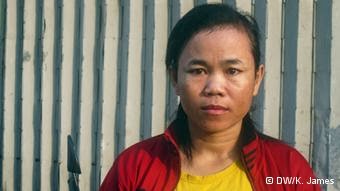 |
| Chenda: 'I cannot live on what I earn, daily life is too expensive' |
Pressure
cooker
According
to human rights monitors, at least 10 people were injured during Sunday's
clashes between hundreds of demonstrators, who eventually turned out, and
security troops. On Monday, riot control police again hit the streets, breaking
up a protest organized by a leading independent broadcaster and making arrests.
The violence is becoming a near-daily event.
But
according to some observers, the current government strategy could backfire. As
the tensions mount, past efforts at stopping protests have further turned up
the heat on what has become a "pressure cooker of anger." Chan Soveth
of the rights group ADHOC says Cambodians are getting angrier in the wake of the
crackdowns.
"The
country is controlled by the armed forces and the rights of the people are
being curtailed," he said. "If this continues, we could see people
starting to use violence against the authorities."
 |
Cambodian
military police disperse a protest in Phnom Penh on Jan. 27,
2014. (AFP
Photo/Tang Chhin Sothy)
|
Related Article:
No comments:
Post a Comment
Note: Only a member of this blog may post a comment.