From January, the UN's ILO will resume naming garment factories that fail to meet minimum demands of Cambodian law. That follows years of declining working conditions in what is regarded abroad as a model industry.

The
decision follows a scathing report in February from Stanford Law School that
looked at the ILO's 12-year-old assessment programme known as Better Factories
Cambodia (BFC). Stanford's report, titled "Monitoring in the Dark,"
found conditions have worsened in recent years and that workers now earn less
in real terms than a decade ago.
The report
said much of the blame lay with the ILO after it decided BFC would no longer
make public the names of failing factories. The ILO took that decision after
Cambodia's trade preferences deal with the United States expired in 2005.
Jason Judd,
the ILO's technical specialist on the BFC program, says a number of factors fed
into its decision to name factories that do not comply. The Rana Plaza collapse
in Bangladesh in April, in which more than 1,000 workers died, changed how the
industry views transparency, while incidents in Cambodia around that time in
which workers were killed or injured have also contributed to a rethink.
Also
relevant is that BFC monitors have witnessed a deterioration of working
conditions in Cambodian factories, many of which are now less compliant with
the Labour Law than three years ago.
"That's
not true in every factory, but on the whole this is what we've seen," says
Judd. "[So] we've chosen just a handful of issues to focus on and they
include the basics - things that all workers should be able to count on: that
emergency exits are unlocked during working hours, or that they are paid at least
the minimum wages."
And so,
starting Tuesday, ILO inspectors will begin visiting the kingdom's 450-odd
garment exporting factories and giving them a final chance to comply with 21
basic issues.
 |
| A ceiling collapsed at a shoe factory in Cambodia on May 16, killing at least two workers |
Those
unable or unwilling to improve will be named, starting in January. Allowing
"life and limb" risks is unacceptable, says Judd: "No factory
should be allowed to continue and not meet those basic standards … It's not a
very high bar."
Early gains
The growth
in Cambodia's garment manufacturing industry over the past decade has been one
of the country's few economic success stories. The sector started with a
handful of factories and several thousand workers. Today there are around 450
exporting factories - all of which by law must belong to the BFC program - with
400,000 workers, most of whom are young women drawn from rural areas. Garment
exports, the biggest foreign exchange earner, were worth $4.6 billion in 2012.
Much of the
success was due to the carrot and stick approach under the US trade preferences
deal, which tied increases in quotas to improved working conditions. BFC
monitored the factories and, the authors of the Stanford report said, its
approach largely worked.
"During
its early years, BFC played a significant role in the promotion of labour
rights in Cambodia, particularly in the expansion of space for workers'
exercise of freedom of association," the Stanford report noted.
BFC's
failings followed the expiry of the trade preferences deal in 2005 when the ILO
changed its approach. Although BFC inspectors continued to monitor, many
factories - freed from financial incentives to comply and with no risk of being
named and shamed - predictably ignored BFC's written recommendations.
Not-so-model
industry
 |
| BFC monitors have witnessed a deterioration of working conditions in factories; workers have been protesting |
Unsurprisingly
some of the sector's problems have translated into industrial action and - if
statistics from the Garment Manufacturers' Association in Cambodia (GMAC), the
industry body, are any guide - those problems are getting worse.
GMAC's figures
show the sector lost nearly 450,000 days to strikes in the seven months to
July. At that rate, 2013 is set to eclipse 2012's total 542,000 days lost,
which was itself the most disruptive in a decade. Most workers are fed up with
low wages of around $80 a month before overtime as well as poor working and
living conditions.
Dave Welsh,
country director of the Solidarity Center, a non-profit affiliated with the US
labour movement, says the ILO's decision to keep its findings private has
allowed the key stakeholders - factories, brands and the government - to convey
the impression that BFC monitoring meant Cambodia has a model industry.
"That's
very far from the case," he says, adding that the ILO's decision to put
some teeth back into its monitoring programme will provide the useful
"naming and shaming" element of old.
"The
new step that the ILO is taking is one in a positive direction," says
Welsh. "It means in my mind that any of those stakeholders … who don't
want this are admitting in a de facto manner that they can't or won't monitor
the conditions in the workplace factory or, frankly, that they're trying to
hide something. And the second option is more likely."
Welsh notes
that BFC's role is only to monitor; the responsibility to enforce the law against
errant factories lies with poorly-paid government officials. He also says that
while some brands have welcomed the ILO's revised remit, others are being
disingenuous.
Fallout?
However, if
unions, rights groups and some brands - including Sweden's H&M - are in
favour of the ILO's revised monitoring approach, the government has pronounced
itself fearful of the possible consequences. Sat Samoth, a senior Ministry of
Labour official, told local media last week that he believed publicising the
names of failing factories could put off international buyers and cost jobs.
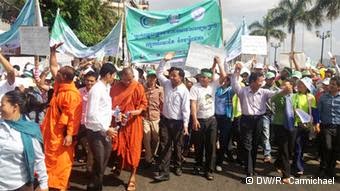 |
| According to GMAC figures, the sector lost nearly 450,000 days to strikes in the seven months to July |
As a
result, GMAC has told its members that, unless BFC inspectors are accompanied
on their surprise visits by a labour ministry official or are armed with a
letter from the government, they can bar them from entering.
"What
we are telling factories is that they are no longer obliged [to grant access].
They take the decision themselves," Loo says, adding that this policy of
non-cooperation will remain in place "until we are accorded the respect we
deserve as a partner" and until GMAC's concerns are addressed.
Rocky road
ahead?
The weeks
ahead will show how successful or otherwise the ILO's revised approach will be.
If BFC inspectors are not able to access factories, then assessing compliance
with the Labour Law will be difficult. Talks to resolve differences between
GMAC and the ILO are likely.
Although
monitoring under the new reporting process is not due to start until Tuesday,
the ILO said on Monday it was still "business as usual" and that none
of its inspectors had been turned away.
Regardless
of the outcome of that spat, the ILO says Cambodia - which has reaped huge
benefits from its image as host to a model industry - needs to improve.
"Countries
like Bangladesh and Vietnam and Indonesia and other competitors have upped
their game," says the ILO's Judd. "If Cambodia wants to maintain this
advantage that comes from a reputation for decent working conditions, it's also
going to have to up its game."
No comments:
Post a Comment
Note: Only a member of this blog may post a comment.