Jakarta Globe - AFP, September 8, 2013
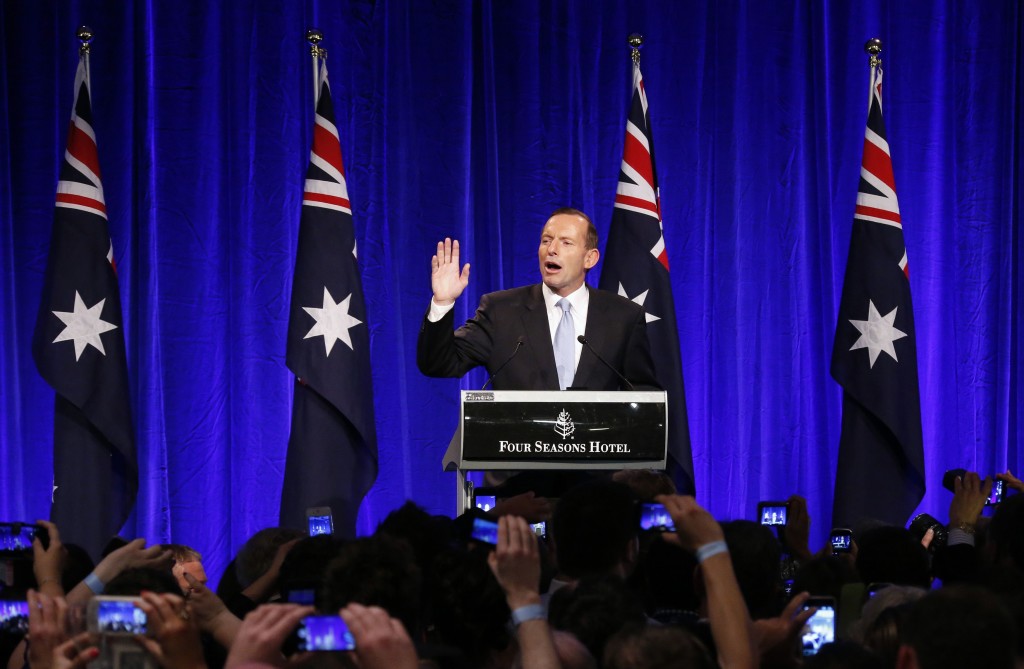 |
| Australia's conservative leader Tony Abbott claims victory in Australia's federal election during an election night function in Sydney on Sept. 7, 2013. (Reuters Photo) |
Australian politics looks set for a period dominated by domestic concerns as new prime minister Tony Abbott seeks to move on from a vitriolic campaign with a focus on local issues, analysts said Sunday.
The
conservative leader, who ended six years of Labor rule with a comprehensive
victory over Kevin Rudd on Saturday, launched his term with a promise to govern
for all Australians and pledging a new emphasis on issues such as roads,
childcare and broadband.
Abbott’s
win would also likely see the seasoned political brawler adopt a more pragmatic
stance as he looks to reinvent himself as a national leader, they said.
“At first
take I would suggest we’re going to see a far more inward-looking government
than we have previously,” said Norman Abjorensen, from the Australian National
University’s College of Asia and the Pacific.
“I think
the foreshadowed cuts to our foreign aid budget last week really put the
writing on the wall that we’re going to look at domestic policy as being
all-important,” he added, referencing Abbott’s pledge to slash Aus$4.5 billion
(US$4.2 billion) from overseas development spending.
In contrast
to Mandarin-speaking former diplomat Rudd and his “Australia in the Asian Century”
objectives, Abbott had not shown a “flicker of interest” in foreign affairs
through his political career, Abjorensen said.
Abbott was
ridiculed in some quarters for describing the conflict in Syria as “baddies
versus baddies” during the election race.
The
one-time trainee Catholic priest has held conflicting positions on Asia,
downplaying the importance of China’s rise in his 2009 political manifesto
“Battlelines” and emphasising the importance of what he called the
“Anglosphere”.
However he
vowed during the election campaign to put Asia at the centre of his foreign
policy agenda.
Abbott has
been a combative and divisive figure in opposition and will need to convince
both the electorate and his own party of his credentials for top office.
“What it
will essentially mean is a transformation of this political street-fighter,
someone who in some ways has never transcended the cut-and-thrust of student
politics, into national statesmanship,” Abjorensen said.
Abbott
promised a “no surprises, no excuses” government in an open letter to the
Australian people published in Sunday newspapers focused solely on domestic
imperatives — slashing taxes, building roads and rolling out broadband.
He said
“Operation Sovereign Borders” — his military-led initiative to turn back
asylum-seeker boats from Indonesia — would be authorised on his first day of
office.
Abbott has
promised to make the Southeast Asian nation his first stop as prime minister —
an unusual step for a Liberal leader, with London or Washington being a more
traditional choice.
But
Abjorensen said Abbott would have some fence–mending to do over his plans to
send Australian police to Indonesia, pay locals for information and buy up
Indonesian fishing boats in a bid to stymie the people-smuggling trade, which
have met resistance in Jakarta.
“I think
that will be the very first test of how this government wants to be seen, wants
to shape some sort of image in the immediate region,” he told AFP.
Shaun
Carney, politics professor at Monash University, said Abbott’s time in
opposition had been characterised by “power through aggression”.
Now he was
in office, the “hysterics” would be abandoned in favour of a more pragmatic, if
not “cynical”, approach on most matters except climate change, Carney said.
Business-backed
Abbott has vowed to tear up Labor’s pollution tax as his “first legislative
priority” and threatened to call another election if he is blocked by the
environmentally driven Greens party in the Senate.
Abbott has
proposed a so-called “Direct Action” plan to tackle pollution in Australia —
among the world’s worst per capita emitters due to its dependence on coal-fired
power stations and mining industry.
The plan
combines incentive payments to business to cut their emissions and a
controversial soil sequestration scheme for carbon.
Greg
Craven, vice chancellor of the Australian Catholic University, said Rhodes
scholar Abbott was far from a typical conservative and it would be wrong to
typecast him or his party.
“This is
not the old caricature,” said Craven. “This will be a government seeking to
marshal some very different trains of thought.”
Agence France-Presse
No comments:
Post a Comment
Note: Only a member of this blog may post a comment.