Most of
India's royal families do not enjoy the same privileges as they did long ago.
But many among them, especially women, are now playing an important role in the
development of society.
Devyani
Rana, who is married to Kunwar Aishwarya Singh, a member of the royal Indian
Rana family, is a busy woman these days. She is focused and is keen to make a
dent in the social sector. Armed with a master's degree from the London School
of Economics, Rana, whose mother Usharaje Scindia is from the Gwalior royal
family of Rajasthan, India, works as a consultant for the United Nations
Development Programme.
"I
have also worked for the Schwab Foundation to promote social entrepreneurship.
We have to move with the times. I certainly did not lead a cloistered life
because I was part of the royalty. Gone are those days when royalty was out of
touch with the times," Rana told DW.
While these
royals are dashing and magnetic, and command respect for their blue-blooded
lineage, they have also done their bit to contribute to society. Many do not
want any special treatment simply because of the families into which they were
born.
Princess
Jyotsana Singh of Jammu and Kashmir is one such example. Her grandfather, Hari
Singh was the last ruler of the princely state.
She likes
sculpting and creates abstracts and sculptures in enamel art, an art form
Kashmir is celebrated for. She has also brought it upon herself to keep alive
the tradition of weaving Pashmina [fine cashmere wool] in Jammu.
 |
| 'We have to move with the times:' Devyani Rana |
"We
are only relevant as long as we make ourselves relevant," she told DW.
"If you go harking back to the good old days, you are irrelevant. Sure my
background helped and I have a lot of goodwill in the state and that gave me a
head start for the things I am doing."
Women of
mettle
Sharing
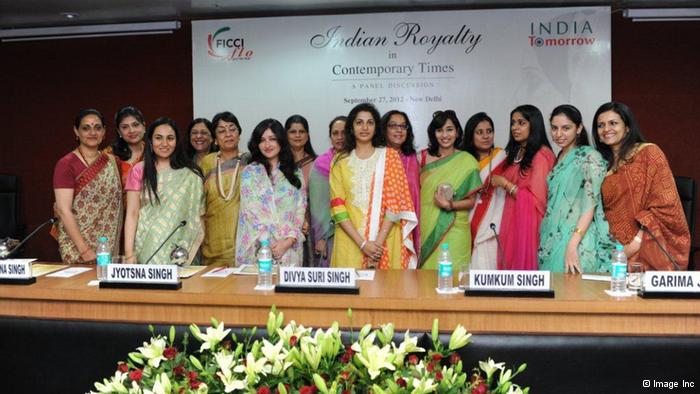
their experiences on September 27 at the Young FICCI Ladies Organization
(YFLO), an exclusive women's wing of the Federation of Indian Chambers of
Commerce and Industry aimed at women empowerment at various levels, members of
India's glamorous royal women felt they could no longer bask in the bubble of
prestige and privilege.
"These
are women of substance. They may hail from royalty but they are playing an
important role in the development of society," said Divya Suri Singh,
chairperson of YFLO.
Though the
government abolished privy purses in 1971 and terminated all royal privileges
and titles, many took to politics as a career.
"My
cousin is a minister in the government and my aunt has been a chief minister.
People have voted for them because they have done work for the people. They
have made a mark and are doing innovative things," said Devyani, who has a
strong political lineage as well.
Like many
of India's former aristocrats, who have transformed their assets to heritage
hotels or build luxuriant palaces, Princess Divya Singh family, too, built the
holiday resort in Shimla in Himachal Pradesh.
Their
resort Woodville has been a site for many royal weddings and has an impressive
history dating right back to 1866.
"Be it
politics, sports, fashion or heritage tourism, royalty has made a mark in these
areas. They have given it a branding and stature and continue to excel. So we
are certainly relevant and in synch with the times," Princess Divya Singh,
33, told DW.
The event
in New Delhi made clear: the glamour and indulgence associated with royalty is
slowly being exchanged for goodwill.
No comments:
Post a Comment
Note: Only a member of this blog may post a comment.