guardian.co.uk,
Reuters in Kuala Lumpur, Saturday 28 April 2012
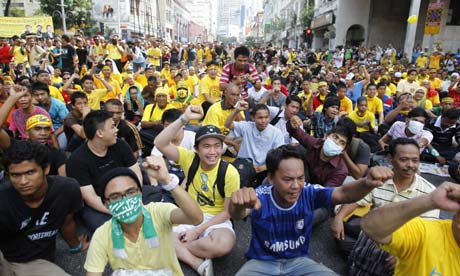 |
| Protesters of the Bersih (Clean) group shout slogans near Dataran Merdeka, also known as Independence Square, in Kuala Lumpur Photograph: Bazuki Muhammad/REUTERS |
Up to
20,000 protesters calling for fair elections and greater accountability marched
on Kuala Lumpur's centre on Saturday in a show of force that will test the
Malaysian government's reformist pledges and may affect the timing of national
polls.
Police shut
down much of the city centre and closed off the historic Merdeka (Independence)
Square with barriers and barbed wire, enforcing a court order that the
protesters should not enter the symbolically important site.
The Bersih
(Clean) group that is leading the protest says it will obey the ban but will
march as close as possible to the square, raising the possibility of a repeat
of violent clashes that marred Bersih's last major protest in July 2011.
"Now
it looks like we will have to fight for our right to gather at Merdeka Square
as well as fight for free and fair elections," said Muhammed Hafiz, a
28-year-old store clerk who was preparing to join the protest.
Organisers
hope the protest will draw 100,000 people, including thousands demonstrating
against a controversial rare earths plant being built by Australian firm Lynas
on the country's east coast. That would make it the biggest protest since the
"Reformasi" (Reform) demonstrations in 1998 against then Prime
Minister Mahathir Mohamad.
A police
official estimated the protesters numbered 15,000 to 20,000 by midday with just
one arrest reported.
The protest
is a delicate challenge for the government of Prime Minister Najib Razak,
possibly affecting the timing of elections that he is preparing to call as
early as June.
A violent
response by police would risk alienating middle-class voters and handing the
advantage to the opposition in what is shaping up as the closest election in
Malaysia's history, possibly forcing Najib to delay the poll date.
But Najib
must be mindful of conservatives in his party who are wary that his moves to
relax tough security laws and push limited election reforms could threaten
their 55-year hold on power.
Last July's
rally, more than 10,000-strong, ended in violence when police fired tear gas
and water cannons at the yellow-shirted protesters, drawing criticism of a heavy-handed
response and sending Najib's popularity sliding. His approval rating has since
rebounded to 69%, according to one poll.
Police
helicopters buzzed overhead on Saturday morning as protesters gathered. Reuters
correspondents saw about 200 riot police stationed in the square and five water
cannons heading to the site where Malaysia declared independence from Britain.
Bersih, an
independent movement whose goals are backed by the opposition, has a history of
staging influential rallies as Malaysians have demanded more freedoms and
democratic rights in the former British colony that has an authoritarian
streak.
Younger
Malaysians have become more politically active in recent years, chafing at
restrictions on student activism.
"The
younger generation, especially my generation, want to be involved. Look at
Lynas and Bersih. We cannot be quiet," said 19-year-old university student
Chan Mei Fong.
The July
protest was a watershed moment for Najib, prompting him to promise reform of an
electoral system that the opposition says favours the long-ruling National
Front coalition.
The
National Front is trying to recover from its worst ever election result in 2008
when it lost its two-thirds majority in parliament, giving the diverse, three-party
opposition led by former finance minister Anwar Ibrahim real hope of taking
power.
Najib has
replaced tough security laws - ending indefinite detention without trial -
relaxed some media controls, and pushed reforms to the electoral system that critics
have long complained is rigged in the government's favour.
A
bipartisan parliamentary committee set up by Najib this month issued 22
proposals for electoral reform, including steps to clean up electoral rolls and
equal access to media.
But the government
gave no guarantee that any of the steps will be in place for the next election.
Bersih says
the proposals do not meet most of its key demands, including lengthening the
campaign period to at least 21 days from the current seven days. It also wants
an independent audit of the electoral roll and international observers at
polling stations. Bersih and opposition parties say they have unearthed
multiple instances of irregularities in voter rolls, including over 50 voters
registered at one address.
Related Articles:
Malaysian protest over rare earths refinery plan
Malaysia to change laws to boost press freedom
Malaysian protest over rare earths refinery plan
Malaysia to change laws to boost press freedom
No comments:
Post a Comment
Note: Only a member of this blog may post a comment.