Yahoo – AFP, Frank Bainimarama, 30 May 2022
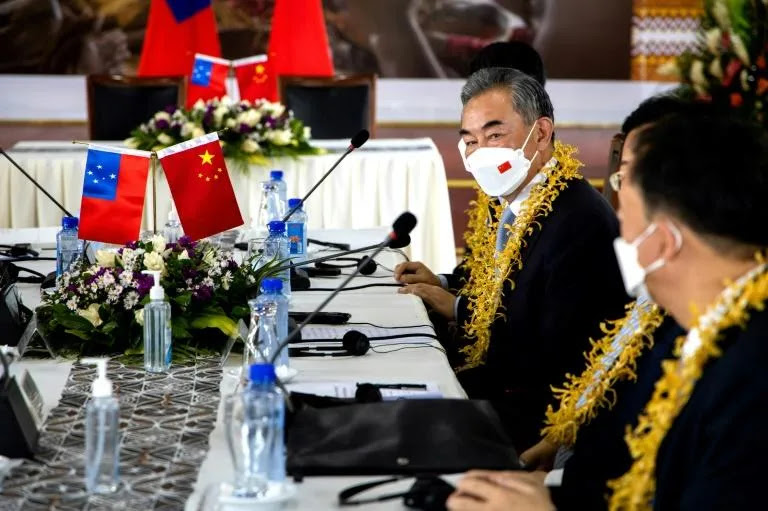 |
| Chinese Foreign Minister Wang Yi has said that that Beijing is willing to work with other major powers in the Pacific region to help island nations develop (AFP/Vaitogi Asuisui MATAFEO) (Vaitogi Asuisui MATAFEO) |
Talks in Fiji between Chinese Foreign Minister Wang Yi and leaders from the small island nations failed to reach an agreement, in a high-profile diplomatic setback for Beijing.
China is offering to radically ramp up its activities in the South Pacific, directly challenging the influence of the United States and its allies in the strategically vital region.
The proposed pact would see Beijing train Pacific island police, become involved in cybersecurity, expand political ties, conduct sensitive marine mapping and gain greater access to natural resources on land and in the water.
As an enticement, Beijing is offering millions of dollars in financial assistance, the prospect of a potentially lucrative China-Pacific islands free trade agreement and access to China's vast market of 1.4 billion people.
Behind the scenes, Pacific leaders have voiced deep misgivings about the offer.
In a recent letter to fellow leaders, David Panuelo, the President of the Federated States of Micronesia, warned the offer was "disingenuous" and would "ensure Chinese influence in government" and "economic control" of key industries.
A more soft-spoken public rebuke came after the talks, when leaders said they could not agree to Beijing's proposed "Common Development Vision" due to a lack of regional consensus.
"As always, we put consensus first," co-host and Fijian Prime Minister Frank Bainimarama said after the meeting, indicating that broad accord would be needed before inking any "new regional agreements".
Papua New Guinea, Samoa and the Federated States of Micronesia were said to be among those concerned about the proposals, along with Taiwan-recognising Palau, which was not invited.
"We would rather deal with our own security issues with China", Papua New Guinea Foreign Minister Soroi Eoe told AFP, indicating concern about any region-wide pact.
Chinese officials -- working frantically to secure support during Wang's 10-day diplomatic blitz of the region -- admitted their entreaties had fallen short.
"There has been general support from the 10 countries," Chinese ambassador to Fiji Qian Bo told reporters in Suva. "But of course, there are some concerns on some specific issues and we have agreed that these two documents will be discussed afterwards until we have reached an agreement."
Speaking from Suva, Wang made the face-saving announcement that the 10 countries had agreed to memorandums of understanding on China's "Belt and Road" infrastructure initiative.
The two sides will "continue to have ongoing and in-depth discussions and consultations to shape more consensus on cooperation", he said, urging those worried by Beijing's intentions not to be "too anxious and don't be too nervous".
The full proposal has not been made public, but was leaked to media including AFP ahead of Monday's meeting.
China has said it will release a "position paper" highlighting the proposals to the public in the coming weeks.
Balancing act
Western powers have bristled against China's move into the region, with the US State Department warning South Pacific nations to be wary of "shadowy, vague deals with little transparency".
Australia joined the United States in urging a spurning of China's attempts to expand its security reach deep into the region, with the country's new foreign minister warning of the "consequences" of such deals.
Many in the Pacific are uneasy at being thrust to the centre of a geopolitical tussle between China and US allies.
Most capitals are keen to maintain amicable ties with China, balancing relations between Beijing, Washington, Canberra and Wellington, while focusing on the more urgent threat of climate change and day-to-day economic issues.
During a joint appearance with Wang, Bainimarama hit out at those engaged in "geopolitical point-scoring".
It "means less than little to anyone whose community is slipping beneath the rising seas, whose job has been lost to a pandemic or whose family is impacted by the rapid rise in the price of commodities", he said.
All but a few of the Pacific Islands are low-lying and deeply vulnerable to sea-level rises caused by climate change.
Before the meeting, President Xi Jinping sent a
message that China would be "a good brother" to the region and that
they shared a "common destiny", according to state broadcaster CCTV.
