Pages

Sunday, April 24, 2022

Dalai Lama urges move to renewable energy to combat climate crisis

France24 – AFP, 23 April 2022 

The Dalai Lama was presented with a block of ice carved from one of the fast-melting
glaciers in India's Himalayan Ladakh region - Office of His Holiness the Dalai Lama (OHHDL)/AFP


New Delhi (AFP) – Tibetan spiritual leader the Dalai Lama urged the public to reduce fossil fuel use during a meeting with activists to mark Earth Day, warning that the climate change crisis transcends national boundaries.
 

The 86-year-old -- who is now living in exile in India's Dharamshala -- was presented Friday with a block of ice carved from one of the fast-melting glaciers in India's Himalayan Ladakh region. 

Mounted on a wooden stand, the hunk of ice was meant to highlight the effects of climate change on the Tibetan plateau. 

"In my own life I have witnessed the decline in snowfall, first in Tibet and later, in Dharamshala," the Dalai Lama said during the Earth Day event. 

He urged for the adoption of renewable sources of energy to mitigate the crisis that is posing a threat to the entire human race. 

"We need to take urgent steps to reduce our reliance on fossil fuels and adopt renewable sources of energy such as those that rely on the wind and the power of the sun," he added. 

"The threat of climate change is not limited by national boundaries -- it affects us all." 

The Himalayan ice block expedition covered around 250 kilometres (155 miles), with the trekkers travelling on foot, bicycle and in electric vehicles to raise awareness about the effect of fossil fuels on glaciers. 

They also used low-carbon technologies to keep their sample from melting.

Saturday, April 9, 2022

Pink Floyd release first new song since 1994 for Ukraine

Yahoo – AFP, April 7, 2022 
David Gilmour: 'We, like so many, have been feeling the fury and the frustration of this vile
act of an independent, peaceful democratic country being invaded and having its people
murdered by one of the world's major powers' (AFP/JOHN D MCHUGH) (JOHN D MCHUGH)

Pink Floyd have written their first new song in almost 30 years to support Ukrainians, the band announced on Thursday. 

"Hey, Hey, Rise-Up!" will be released on Friday, and be used to raise funds for humanitarian causes linked to the war. 

It samples Andriy Khlyvnyuk, from one of Ukraine's biggest bands BoomBox, singing in Sofiyskaya Square in Kyiv in a clip that went viral. 

Khlyvnyukh abandoned a world tour to return to Ukraine and help defend his country. 

"We, like so many, have been feeling the fury and the frustration of this vile act of an independent, peaceful democratic country being invaded and having its people murdered by one of the world's major powers," Pink Floyd said on their official Twitter feed. 

In a press release, band leader David Gilmour said he had been moved by Khlyvnyuk's video: "It was a powerful moment that made me want to put it to music." 

He was able to speak with Khlyvnyuk from his hospital bed in Kyiv, where the singer was recovering after being hit by shrapnel in a mortar attack, the record company said. 

"I played him a little bit of the song down the phone line and he gave me his blessing. We both hope to do something together in person in the future," Gilmour said. 

The image accompanying the song is of a sunflower, and was inspired by a viral video showing a Ukrainian woman insulting two armed Russian soldiers. 

In it, she tells the soldiers: "Take these seeds and put them in your pockets. That way sunflowers will grow when you all rest here." 

It is the first original music from Pink Floyd since 1994's "The Division Bell". 

Gilmour tweeted his opposition to the war soon after Russia's invasion, saying: "Putin must go". 

The band has also pulled their music from Russian and Belarusian streaming sites in protest at the invasion.


Friday, April 8, 2022

Qatar security guards trapped in 'forced labour': Amnesty

Yahoo – AFP, April 7, 2022 

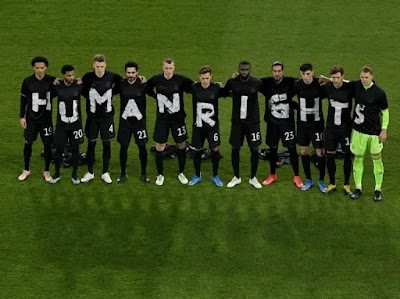
Concern for the human rights of Qatar's army of migrant labourers has refused to go
 away as the World Cup nears, despite promised reforms by the emirate's rulers
(AFP/Tobias SCHWARZ) (Tobias SCHWARZ)

The UN labour agency joined Amnesty International Thursday in calling on World Cup hosts Qatar to protect thousands of security guards who a report said were victims of "forced labour". 

Guards posted at World Cup stadiums, ministries and offices often had to work months, sometimes years, without a day off, Amnesty said in a study. 

Qatar, where the World Cup starts on November 21, insists it has cracked down on hundreds of "unscrupulous" companies, but acknowledged that abuses still take place. 

An army of migrant labourers from Africa and Asia work as poorly paid guards across the tiny emirate whose energy wealth has fuelled a construction boom. Thousands more are being taken on for the World Cup. 

Amnesty said 34 current or former guards it interviewed "described routinely working 12 hours a day, seven days a week -- often for months or even years on end without a day off". One Bangladeshi guard said he did not get a day off for three years. 

"Physically and emotionally exhausted, workers kept reporting for duty under threat of financial penalties -- or worse, contract termination or deportation," said Stephen Cockburn, an Amnesty researcher. 

Those who took a legal weekly day off often had wages cut, Amnesty added. Guards also lost money for taking a toilet break without getting cover, taking a day off sick or just wearing their uniform "improperly". 

The men complained that they had to work outside in Qatar's notorious summer, when temperatures hit 50 degrees Celsius (122 Fahrenheit). 

Guards from Uganda and Kenya said they had more jobs in the heat and received lower wages than other nationalities. 

Work or deportation

Following previous criticism, Qatar in 2017 introduced a minimum wage, cut the hours that can be worked in heat and ended part of a system which forced migrant workers to seek employers' permission to change jobs or even leave the country. 

But Amnesty said there is still a "massive power imbalance" between employers and migrant workers in Qatar, where trade unions are banned. 

"Qatar's laws on working time for security guards are clear but are too often violated," said Max Tunon, head of the UN's International Labour Organisation office in Doha. 

Overtime must be "voluntary, limited and paid at a higher rate" in line with the law, he added. 

In a veiled reference to World Cup organisers and other major Qatari enterprises, Tunon said: "Clients contracting security companies should do their due diligence and monitor the treatment of guards, including their working hours and living conditions." 

Qatar's World Cup Supreme Committee for Delivery and Legacy confirmed that three security companies involved in last year's Club World Cup and FIFA Arab Cup tournaments had been "blacklisted" from future projects. 

The three were found to be in "completely unacceptable" breaches of its Workers Welfare Standards. 

The committee said that in all, seven contractors had been blacklisted from its projects and more than 220 were on a watchlist. Fifty companies had been blocked by the labour ministry from World Cup projects. 

The committee said there will always be "contractors attempting to beat the system, regardless of stringent regulations or monitoring." 

The labour ministry said cases of abuse were falling and the Amnesty report had ignored progress made in Qatar since it was awarded the World Cup in 2010. "The reality is that no other country has come so far so quickly, but for some the pace of change will never be fast enough."